模式特点
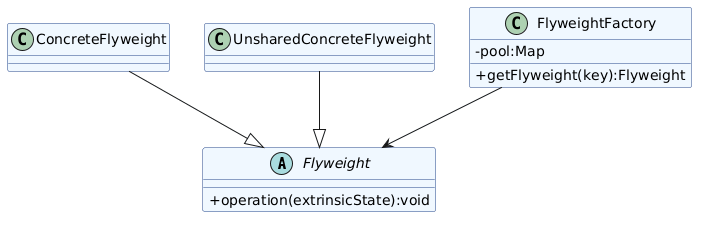
运用共享技术有效地支持大量细粒度的对象。享元模式通过共享对象来减少内存使用,将对象状态分为内部状态(共享)和外部状态(不共享)。
- 内部状态:不变的部分,可被多个对象共享
- 外部状态:变化的部分,由客户端传入
- 通过享元工厂管理共享对象的创建和缓存
- 大幅减少相似对象的内存占用
类图
应用场景
- Qt 中 QString 的隐式共享(Copy-On-Write)机制
- 游戏中的粒子系统:大量粒子共享纹理和模型
- 文本编辑器中的字符渲染:共享字形数据
- 地图瓦片:相同图块共享渲染数据
- 线程池:复用线程对象避免频繁创建销毁
示例代码(C++)
// 享元对象 - 共享的纹理
class Texture {
    std::string m_type;  // 内部状态(共享)
public:
    Texture(const std::string& type) : m_type(type) {
        std::cout << "加载纹理: " << type << std::endl;
    }
    void render(int x, int y) {  // x,y 为外部状态
        std::cout << "渲染 " << m_type << " 在(" << x << "," << y << ")" << std::endl;
    }
};

// 享元工厂
class TextureFactory {
    std::map<std::string, Texture*> m_pool;
public:
    Texture* getTexture(const std::string& type) {
        if (m_pool.find(type) == m_pool.end())
            m_pool[type] = new Texture(type);
        return m_pool[type];  // 复用已有对象
    }
};

// 使用:1000个粒子只创建3种纹理
TextureFactory factory;
for (int i = 0; i < 1000; i++) {
    Texture* tex = factory.getTexture(i % 3 == 0 ? "fire" : i % 3 == 1 ? "smoke" : "spark");
    tex->render(i % 100, i / 100);
}